




Listen to this article with AI
Dubai International Airport continues to hold its position at the top of global aviation. According to the latest 2025 rankings released by OAG Aviation Worldwide, DXB remains the world’s busiest airport for international travellers, reinforcing its status as a central hub for long-haul global travel. While the international title is familiar, the broader context has changed. The latest data places Dubai within close reach of the world’s busiest airport overall, prompting renewed attention on how global airport rankings may evolve in the coming years.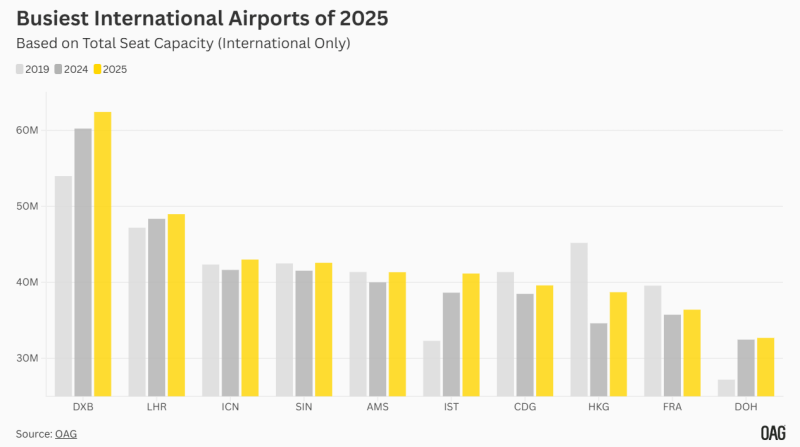
DXB Retains Its International Leadership
Dubai International Airport recorded 62.4 million international seats in 2025, securing its position as the busiest airport globally for international travel. The lead remains significant. London Heathrow Airport followed with 49 million international seats, leaving a 13.5 million seat difference between the two international hubs. The figures confirm DXB’s continued strength in international connectivity and its role as a preferred gateway linking Europe, Asia, Africa, and North America. This consistency places Dubai at the center of airline network planning and reinforces its role in global passenger flows.
Overall Rankings Highlight a Narrow Gap
When domestic and international capacity are counted together, Hartsfield-Jackson Atlanta International Airport continues to hold the top global position with 63.1 million total seats in 2025. Dubai International Airport follows closely, separated by approximately 700,000 seats. The narrowing distance has drawn industry focus to how the rankings may shift as capacity strategies adjust. Growth patterns further define the picture. Atlanta recorded 1 percent year-on-year growth, while Dubai posted 4 percent growth during the same period. DXB’s total capacity now stands 16 percent above its 2019 level, according to OAG data. OAG has noted that Dubai is closing the gap within the overall rankings, placing attention on how long the current order may remain unchanged.
Passenger Experience Remains a Key Factor
Dubai International Airport continues to prioritize passenger efficiency and comfort. Biometric Smart Gates process travelers in under 13 seconds, streamlining arrivals and departures. Beyond processing speed, DXB maintains a range of passenger amenities including wellness facilities, cinemas, leisure areas, and relaxation spaces. These offerings remain a defining feature of the airport’s appeal for travelers and airlines alike.
Other Global Airports in Focus
Tokyo Haneda Airport ranked third globally with 55.4 million seats, maintaining a stable presence among the top tier. Istanbul Airport placed fifth globally, recording 22 percent growth compared to 2019, positioning it among the fastest-growing hubs in the rankings. Singapore Changi Airport ranked fourth for international capacity with 42.6 million seats, remaining a major international gateway.
Dubai International Airport continues to lead global aviation for international travel while drawing increasing attention within overall capacity rankings. With passenger projections pointing to 96 million in 2026 and 100 million by early 2027, global observers remain focused on how the rankings may develop. Atlanta retains the overall lead for now. The margin separating the two airports continues to attract close attention.