
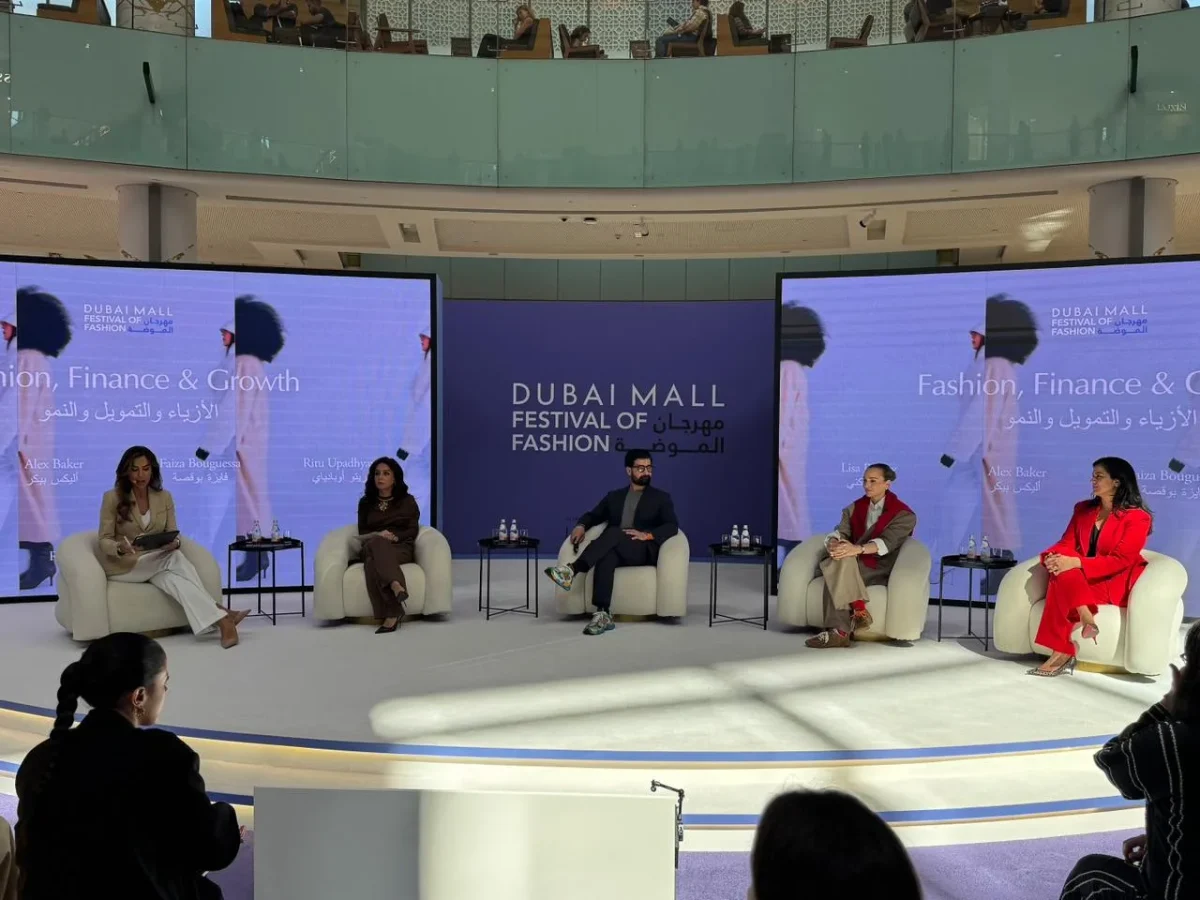
Dubai’s growing influence in global fashion investment took centre stage at the Dubai Mall Festival of Fashion, where industry leaders revealed how the Middle East has evolved from a luxury consumer market into a major hub for fashion finance.
The discussion took place during a panel titled Fashion, Finance & Growth, moderated by Ramia Farrage, and featured senior figures from international media, fashion, investment and brand strategy. Panelists included Ritu Upadhyay, Bureau Chief at Women’s Wear Daily (WWD), Faiza Bouguessa, founder of luxury label Bouguessa, angel investor and Retail Tech X CEO Alex Baker, and brand strategist Lisa Rokny.
Middle East luxury market valued at $90 billion
Setting the context, Upadhyay highlighted the scale and maturity of the regional fashion economy, citing estimates that place the Middle East luxury fashion market at approximately $90 billion.
She noted that the region has undergone a structural shift, moving beyond consumption into brand creation, capital deployment and long-term investment. According to Upadhyay, global attention has increasingly turned to the Gulf as growth in other luxury markets, particularly China, has slowed.
She also pointed to regional retail groups such as Chalhoub Group expanding their role from franchise operators to equity investors in international fashion brands, signalling deeper integration into the global fashion ecosystem.
Founders urged to prioritise mentorship before funding
Bouguessa shared insights from her experience building an internationally recognised fashion label over more than a decade without taking external investment. She stressed the importance of operational clarity and mentorship before pursuing funding.
Bouguessa described a formative period working closely with designer Roland Mouret, which she said provided critical guidance on brand structure and growth. She warned that raising capital too early can amplify existing business challenges rather than resolve them.
Panelists agreed that investors increasingly favour founders who demonstrate sustainability, discipline and long-term vision rather than rapid expansion driven by early funding.
Investors seek balance between creativity and operations
Baker outlined what investors look for when backing fashion businesses, emphasising the need for both creative leadership and strong operational management. He described this as a balance between artistic vision and executive capability, noting that successful brands require both to scale effectively.
He added that founders who raise capital without a clear understanding of costs, margins and logistics often struggle to maintain investor confidence over time.
Equity-for-services model gains traction
Rokny highlighted a growing trend within the region’s fashion ecosystem: equity-for-services partnerships. Under this model, advisory firms provide strategic, branding or operational support in exchange for equity rather than upfront fees.
She said the approach allows early-stage designers to access professional expertise while aligning advisors more closely with long-term brand performance.
Long-term growth over quick exits
The session concluded with a discussion on exit strategies, with panelists noting that fashion brands often differ from technology startups in their approach to ownership and growth. Rather than pursuing rapid exits, founders tend to prioritise brand integrity and sustainable expansion.
Upadhyay cited recent examples of fashion founders partnering with family offices instead of large conglomerates, reflecting a preference for patient capital that respects creative identity.
As the Dubai Mall Festival of Fashion continues to expand its business-focused programming, the panel underscored Dubai’s growing role as a global meeting point for fashion, finance and investment strategy.