




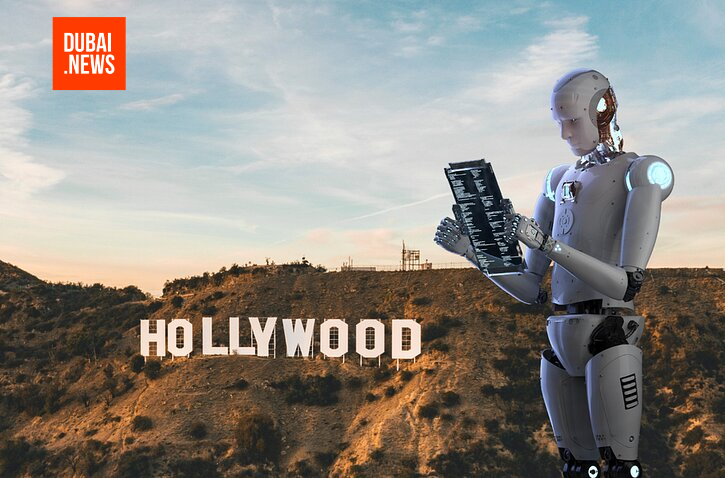
The AI studio surge in Hollywood is no longer speculative — it is measurable, funded, and operational. Venture capital is flowing into AI video generation companies at record levels, fundamentally reshaping who controls production tools and, by extension, storytelling itself.
According to industry reporting, global funding for AI video generation companies reached $3.08 billion in 2025, a nearly 95% increase from 2024. That capital is accelerating the buildout of AI-native production infrastructure, raising urgent questions about labor, intellectual property, and audience acceptance.
Hollywood’s AI studio boom may mark the most significant structural shift in filmmaking since the digital transition.
Runway and the Rise of AI “World Models” in Hollywood
Runway has become one of the central players in Hollywood’s AI studio transformation. On February 10, 2026, Runway closed a $315 million Series E round, nearly doubling its valuation to $5.3 billion. Major investors include Nvidia, General Atlantic, Adobe Ventures, AMD Ventures, Fidelity, and Felicis.
Originally known as a text-to-video generator, Runway now positions itself around “world models” — generative systems designed to simulate complex physical and narrative environments rather than just short clips.
For Hollywood, this represents a shift from AI as a tool to AI as infrastructure.
In September 2024, Runway partnered with Lionsgate to build a custom AI video model trained on Lionsgate’s proprietary catalog of over 20,000 titles. The model focuses on pre-production and post-production tasks, embedding AI directly into a major studio pipeline.
This partnership signals a broader trend: AI vendors moving from external service providers to core production collaborators.
Luma AI’s $900 Million Bet on AI Film Production
Luma AI raised $900 million in late 2025, led by Saudi Arabia’s state-backed AI company Humain. The round valued Luma at approximately $4 billion and included plans to build a 2-gigawatt AI computing cluster known as Project Halo.
CEO Amit Jain has stated that the first movie “significantly aided by AI” is expected in 2026, though likely short-form or mid-form content rather than a theatrical feature.
Luma’s Dream Machine platform already serves creative users worldwide. Its Ray3 reasoning video model has been benchmarked competitively against leading generative models.
The strategic positioning is clear: Luma aims to be a foundational AI model provider, with Hollywood as one of several vertical markets.
Promise: The AI-Native Hollywood Studio Model
Unlike Runway and Luma, Promise is not building tools — it is building an AI-native entertainment studio.
Founded by George Strompolos alongside Jamie Byrne and filmmaker Dave Clark, Promise integrates generative AI across development, production, and post through its internal platform MUSE.
Backed by Peter Chernin and Andreessen Horowitz, Promise represents a direct bet that AI can power full narrative productions audiences will accept.
This is not augmentation. It is structural redesign.
Labor, IP, and the SAG-AFTRA Tension
The AI studio boom has intensified labor concerns across Hollywood.
SAG-AFTRA has actively confronted AI misuse, particularly around deepfakes and unauthorized digital likenesses. Guardrails have already been negotiated in some instances, but broader frameworks are still evolving in 2026.
The core tensions include:
-
Intellectual property rights in training data
-
Digital likeness protections for performers
-
AI-driven cost reduction in VFX and post-production
-
Contractual clarity around generative tool usage
Studios argue that proprietary training models avoid copyright violations. Critics remain skeptical. Legal and ethical precedents are still forming.
Audience Acceptance: The Unanswered Variable
One major unknown remains: will audiences embrace AI-assisted filmmaking?
To date, there has been limited data on box office performance of projects openly using heavy AI production. Early AI-generated social content has drawn mixed reactions — fascination and ridicule in equal measure.
The venture capital thesis assumes audiences ultimately prioritize story and quality over process. But empirical proof is limited.
Generational shifts may change this dynamic. Emerging AI-focused film schools are training creators who see generative tools as native rather than disruptive. Over time, audience perception may normalize accordingly.
What the Hollywood AI Studio Boom Means for Filmmakers
For independent creators, the AI studio boom presents both risk and opportunity.
-
Competition among AI platforms is accelerating innovation
-
Subscription pricing remains competitive
-
Production efficiency tools are becoming accessible beyond major studios
Studios embedding AI into workflows signals where the industry is heading. Fluency in generative tools is increasingly a professional asset.
The labor and IP debates will continue, but the direction of travel is clear: AI is becoming embedded in the filmmaking stack.
Hollywood may indeed be at a breaking point — not because AI is replacing film, but because it is redefining how film is made.
The infrastructure is built. The capital is committed. The next question is cultural acceptance.
And that answer will shape the next decade of cinema.