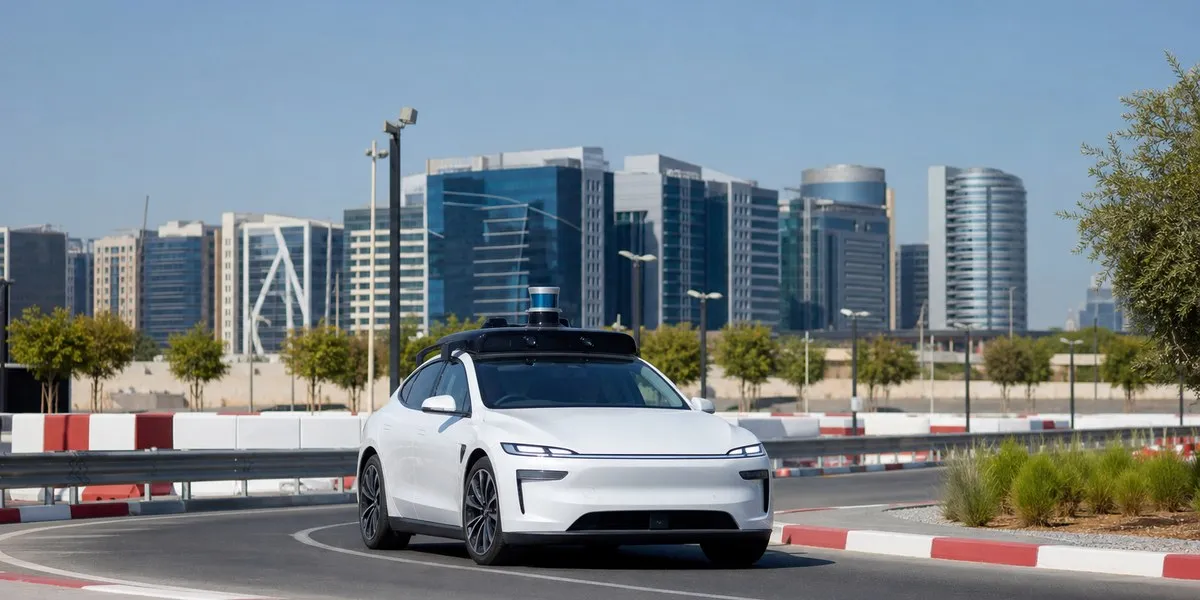
Dubai has opened Dubai Mobility Labs, a dedicated testing complex for autonomous vehicles in Dubai Silicon Oasis, giving the emirate a controlled environment in which driverless systems can be put through their paces before they are turned loose on one of the region's busiest road networks.
The facility is a joint undertaking between Dubai's Roads and Transport Authority (RTA) and the Dubai Integrated Economic Zones Authority. It combines a multifunctional testing area with purpose-built tracks, allowing developers to stage road situations that would be impractical — or unsafe — to rehearse in live traffic.
The opening marks a shift in how the emirate approaches autonomous mobility. Rather than moving straight from private development to public deployment, vehicles now face a formal screening stage with defined criteria to clear.
A closed course and a real road
Dubai Mobility Labs is built around two complementary testing environments.
The first is the controlled site itself, where engineers can reproduce specific road scenarios on demand and repeat them as often as needed — the kind of consistency that is impossible to achieve in ordinary traffic, where no two situations unfold identically.
The second is a designated public-road route running from Dubai Silicon Oasis to Al Qudra. Once a vehicle has demonstrated competence on the closed course, it can be assessed against genuine traffic, real road users and the unpredictability that comes with them.
That staged progression — controlled first, public second — is the structural logic of the facility. It allows failures to surface in a setting where the consequences are contained.
What 248 scenarios are designed to catch
Vehicles at the site are evaluated across 248 distinct scenarios, a figure that indicates just how granular the assessment is intended to be. Among them are the vehicle's responses to demanding road and weather conditions — a meaningful consideration in a region where summer heat, glare, sandstorms and occasional heavy rain each present distinct challenges to camera and sensor systems.
The evaluation examines several layers of an autonomous system. Perception is one: whether the vehicle accurately registers what is around it. Decision-making is another: whether it selects an appropriate response to what it has perceived. Testing also covers how well a vehicle adapts when traffic conditions shift mid-journey, and whether it is ready to progress to public trials and, eventually, full-scale operation.
Those last two thresholds matter. The facility is not simply a proving ground but a gateway, with the authority to determine which systems advance and which return for further development.
Names already through the gates
According to The National, autonomous driving technologies and vehicles from WeRide, Pony.ai and Tesla have already been tested successfully at the site.
The mix is instructive. WeRide and Pony.ai are both Chinese autonomous-driving specialists with robotaxi operations in several markets, while Tesla approaches the problem from a very different technical direction. Having all three pass through the same 248-scenario assessment gives Dubai a standardised basis for comparison across competing approaches — something regulators elsewhere have struggled to establish.
An independent operator runs the tests
In a notable governance decision, the German testing and certification firm Dekra has been appointed to operate Dubai Mobility Labs for an initial three-year term. Dekra will handle day-to-day operations, organise the testing programme and ensure the facility adheres to international safety standards and operational practice.
Placing an independent third party in charge separates the body conducting the assessment from the companies being assessed — a distinction that carries weight when the results determine whether a vehicle is permitted to carry members of the public.
The 2030 target behind it all
Matar Al Tayer, Director General and Chairman of the Board of Executive Directors of the RTA, said the project supplies the infrastructure needed to test advanced transport technologies under both controlled and real-world conditions.
He framed the laboratory as one component of the Dubai Smart Self-Driving Transport Strategy, which aims to convert 25 per cent of all journeys in the emirate to autonomous mode by 2030.
That target is ambitious by any measure, and it explains the scale of the investment. Reaching one in four trips within roughly four years requires a steady pipeline of vehicles cleared for service — which in turn requires testing capacity capable of processing them without becoming a bottleneck.
A second site across the city
Dubai Mobility Labs is not the emirate's only autonomous testing ground. In September 2025, Dubai announced a 15-square-kilometre testing zone spanning Festival City and Dubai Creek Harbour, designated for autonomous taxis, delivery vehicles and other service fleets.
Between them, the two sites cover different stages of the same pathway: the Silicon Oasis complex handles technical validation of the vehicles themselves, while the Festival City zone offers a broader urban area in which cleared fleets can be trialled at something closer to operational scale.
Taken together, they suggest a deliberate sequencing — prove the technology, then prove the service — as Dubai works towards its 2030 goal.